Introduction

Index

Birth of Autodelta Eng.

Birth of Autodelta Ital.

In the beginning:The TZ

All'inizio: TZ Italian

World Championship 75 Eng

World Championship 75 Ita

Page 1- English

Page 2- English

Page 1- Italian

Page 2- Italian

Page 1- German

Page 2- German

1972 Targa Florio-English

1972 Targa Florio Italian

1972 Targa Florio-German

Chiti's Office English

Chiti's Office Italian

Chiti's Office German

Chiti Remembered- English

Chiti Remembered- Italian

Chiti Remembered- German

Meeting Ing.Chiti-English

Meeting Ing.Chiti-Italian

Autodelta Technicians

Mario Andretti English

Mario Andretti Italian

Andrea deAdamich English

Andrea de Adamich Italian

Rolf Stommelen- English

Rolf Stommelen- Italian

Nanni Galli- English

Nanni Galli- Italian

Ignazio Giunti- English

Ignazio Giunti- Italian

Gian Luigi Picchi-English

Gian Luigi Picchi-Italian

Picchi Book Review Engli

Picchi Book Review- Ital.

Picchi Book Review German

Toine Hezemans -English

Albert Ponno-English

Alfa at Le Mans - English

Alfa at Le Mans- Italian

Alfa at LeMans- German

Autodelta Factory Layout

T-33 Chronology- English

T-33 Chronology- Italian

T-33 Chronology- German

Fleron- The First Winner

Fleron- Primo Vincitore

Fleron Der erste Gewinner

GTA 1300,1600: English

GTA 1300,1600: Italian

FIA Homologation GTA

GTAm/Supercharged:English

GTAm/Supercharged:Italian

GTA SA Images

Curated GTA,SA VINS

Scarabeo-105.33 English

Scarabeo-105.33 Italian

Scarabeo-105.33 German

T33 V-8 Stradale English

T33 V-8 Stradale Italian

T33 V-8 Stradale German

Formula 1 Chrono English

Formula 1 Chrono Italian

Formula 1 Chrono German

F1 Motors'70-'85 English

F1 Motori '70-'85 Italian

F1 Engines '70-'85 German

Teodoro Zeccoli English

Teodoro Zeccoli- Italian

Teodoro Zeccoli- German

New Lives T33 English

Nuova Vita T33 Italian

New Lives T33 German

Autodelta in F.1 -English

Autodelta in F.1 -Italian

Autodelta in F.1 -German

Autodelta Transporters

Autodelta Drivers Speak

Ing Gianni Arosio English

Ing.Gianni Arosio Italian

Ing. Gianni Arosio German

Franco Scaglione History

Stradale History English

Stradale History Italian

Stradale History German

Motor Marine Montreal 2.5

Autodelta Fund Raising

Lithographic Alfa Prints

Interesting Extra Photos

Authors' Notes

Visitor Comments

The Death of Autodelta

La Morte dell'Autodelta

Der Tod von Autodelta

"Autodelta Day "

Autodelta cars for sale

Autodelta Vendita Italian

Autodelta GTAs: German

Testing Qui

“La fine dell’Autodelta e la vendita della Alfa Romeo”

Testo di Roberto Motta

Distinguished Italian Motor Sports Journalist 


L’Autodelta, il reparto corse interno dell’Alfa Romeo diretto dall’ingegner Chiti, venne progressivamente smantellata, con una logica politica e partitica. A confermare quanto detto, basta ricordare che l’Alfa Romeo, fino al 1986, era un’azienda dello Stato Italiano, che faceva capo all’IRI, l’Istituto per la Ricostruzione Industriale, allora presieduto da Romano Prodi. 

Era un periodo di ‘tagli’ e il governo intendeva recuperare capitali finanziari  dando il via a una serie di privatizzazioni, e quindi vendere a nuove società, tutto quello che era appetibile.

Tra le aziende che avevano un importante rilevanza economica, ricordiamo l’Alfa Romeo, società cui erano interessate sia la Ford che la FIAT. Quindi i vertici dell’IRI decisero di metterla all’asta. Era ovvio che la vendita di una simile entità industriale avrebbe richiesto tempo e, per renderla più appetibile, andava alleggerita dai costi di gestione del reparto corse.

I piani prevedevano che l’Alfa Romeo mantenesse un’immagine di solidità per essere attraente, quindi, i vertici dell’IRI decisero di privarla del reparto corse, ossia dell’Autodelta.

Tutto questo doveva però doveva avvenire lentamente, senza destare sospetti, e doveva avvenire con una lunga e lenta agonia.

L’Autodelta, era divenuta il reparto corse Alfa Romeo nel 1963, quando la Casa del ‘Biscione’ era capitanata da  Giuseppe Luragi. 

Nei 14 anni della sua presidenza, Luraghi trasformò l’Alfa Romeo in un colosso industriale e ritornò grande nel mondo delle competizioni proprio grazie all’acquisizione della Autodelta.

In questo periodo l'Alfa Romeo si espanse in Italia e all'estero, producendo auto di grandi prestazioni, e l'apertura di un grande e nuovo stabilimento a Pomigliano d’Arco (Napoli). Nel 1973 la Casa del Portello stava vivendo l’ennesimo periodo di crisi economica, e il piano di rialzo previsto da Luraghi fu bocciato. 

La gestione Luraghi fu messa in discussione dallo scontro con il presidente dell'IRI Giuseppe Petrilli, esponente del partito della Democrazia Cristiana), che voleva realizzare un terzo stabilimento Alfa Romeo in Irpinia, territorio elettorale dell'allora ministro dell'Industria Ciriaco De Mita. 

Lo scontro tra Petrilli e Luraghi portò  alle dimissioni di quest’ultimo dall'azienda.

Nel periodo della presidenza Luraghi, l’Autodelta aveva ampiamente dimostrato le sue capacità, tecniche-sportive fino ad arrivare alla vittoria del Mondiale Sport Prototipi nel 1975 e nel 1977, con la favolosa 33TT12. Poi. Con la fornitura dei propulsori alla Brabham e aveva riportato il biscione in F1 con una vettura tutta italiana, tanto che i giornali del settore speravano al ritorno di uno scontro tra l’Alfa Romeo e la Ferrari. Scontro che era già avvenuto nel Mondiale Marche.

Il 30 maggio 1978, insieme a Corrado Innocenti (amministratore delegato) si insediò ai vertici dell'Alfa Romeo Ettore Massaccesi, che annunciò che avrebbe portato l’Alfa Romeo al pareggio di bilancio in quattro anni. Non fu così.

La gestione Massacesi-Innocenti va ricordata come una gestione fatta con la continua presentazioni di piani finanziari-economici che non vennero mai mantenuti. Una gestione farraginosa e scelte fatte di tagli che portarono a un futuro sempre più incerto e a perdite sempre più ingenti che portarono alla difficile situazione sindacale degli stabilimenti del Nord dove evidenziò l’eccedenza di 3500 dipendenti.

Dal 1982 al 1989, presidente dell’IRI fu Romano Prodi, che fu l’artefice di una serie di privatizzazioni di natura schizofrenica dovuta alla sua incapacità di opporsi ai vertici politici.

Con l’arrivo di Prodi all’IRI, e la crescente paura di Massaccesi di essere sollevato dal suo incarico, portò alla fine dell’Autodelta e, poco dopo alla vendita, della Alfa Romeo alla Fiat.


"Ma cosa successe all’interno dell’Autodelta?"


Come accennato, Massacesi diede il via a una serie di tagli indiscriminati, che si riversarono anche sull’attività agonistica. Uno degli eventi che condizionò la competitività dell’Alfa Romeo in F1, fu lo scontro tra la FISA e la FOCA cui aderivano la totalità delle scuderie britanniche. La FISA chiedeva l’abolizione delle ‘minigonne’ per motivi di sicurezza, e la FOCA voleva la messa al bando del propulsore turbocompresso, considerato troppo costoso.

L’abolizione delle minigonne fu uno dei motivi della perdita di competitività della Typo 179, alla quale si aggiunse il ritiro della Goodyear alla fine del 1980.

L’anno successivo fu per l’Alfa Romeo fu un vero calvario e, sulla griglia di partenza Bruno Giacomelli e Mario Andretti difficilmente riuscivano a superare la metà dello schieramento.

A Silverstone, in occasione del Grand Prix di Inghilterra, Gerarde Ducarouge fu licenziato dalla Ligier e, certo delle sue qualità tecniche, Ing. Chiti convinse i vertici Alfa ad assumerlo.

Il ‘Duca’ entrò a far parte, come consulente, dell’Autodelta a partire dal Grand Prix d’Austria a metà agosto e, con il suo aiuto, la 179 diventò più competitiva fino a conquistare il 3° posto, con Giacomelli, al Grand Prix di Las Vegas.

Ducarouge puntò subito alla gestione operativa dell’Autodelta, e si propose ai vertici Alfa Romeo come la persona adatta a sostituire Ing. Chiti.

Per i vertici Alfa Romeo era una occasione d’oro per ridimensionare Chiti e l’Autodelta in vista della vendita della Casa.

Nei primi giorni del 1982, Chiti fu nominato Presidende dell’Autodelta, Mario Felice Direttore Generale, cui fu affidata la gestione economica, e Ducarouge assunse il ruolo di Direttore Tecnico e gli venne affidata la gestione operativa. Ing. Chiti fu così messo all’angolo e non avrebbe potuto interferire sulle scelte di Ducarouge.

Con la Typo 182, l’Alfa affrontò una stagione interessante, ma il clima all’Autodelta iniziò a degenerare rapidamente e Massacesi guardava alla F1 sempre più apprensione.

I vertici dell’IRI premevano perché si ottenessero risultati e, nel frattempo, non intendevano mettere a disposizione un ulteriore apporto economico. Tutto questo mentre anche l’Alfa Romeo stava affrontando l’ennesimo periodo economico negativo.

Massaccesi pensò di tornare alla sola fornitura dei motori, scelta che sarebbe stata meno traumatica che un ritiro dalle competizioni a partire dal 1983.

Il suo mandato stava per finire e Massacesi, dopo che ai vertici dell’IRI fu nominato Prodi, mirava ai vertici della Finmeccanica, una multinazionale italiana specializzata in aerospazio, difesa e sicurezza e non intendeva sobbarcarsi le spese dell’Autodelta che nel solo 1982, aveva speso 15 miliardi di Lire, il 10% delle perdite totali dell’Alfa Romeo.

Quindi Massacesi era pronto a raccogliere i consigli di chiunque avesse potuto porre fine ai suoi travagli.

Puntualmente, si presentò il genio di turno: Nicolò di San Germano, giovane e ‘brillante’ manager in cerca di gloria, della Philips Morris, destinato dalla Casa Madre di Losanna a seguire la sponsorizzazione dell’Alfa Romeo.

San Germano propose alla dirigenza della Casa milanese di cedere in gestione la squadra di Formula 1 e di affidarne la gestione al team Euroracing, scuderia di Gianpaolo Pavanello distintasi in Formula 3 vincendo campionati italiani ed europei.

Secondo l’ottuso uomo Marlboro, una simile scelta avrebbe garantito l’abbattimento dei costi di gestione e l’aumento del gettito delle sponsorizzazioni poiché l’attività sportiva della Casa non sarebbe più stata gestita da una ‘azienda di stato’, bensì da un’agile organizzazione privata. Detto questo, Massaccesi decise di affidare all’Euroracing la gestione della squadra di Formula 1 a partire dalla stagione 1983.

Tutto il materiale Autodelta fu dato in comodato, ossia gratis, all’Euroracing, e la nuova scuderia avrebbe potuto contare sulla fornitura dei motori turbo 8 cilindri e sull'assistenza tecnica dell'Autodelta. Nello stesso periodo, Massacesi pensò di trasferire la costruzione dei motori all’interno dell’Alfa Romeo, eliminando l’Autodelta e liberandosi di Chiti. A tale proposito furono allertati gli ingegneri Surace e Russo.


Era la fine.


La storia dell’Alfa Romeo F1 e dell’Autodelta finirono qui e, come dice una famosa canzone italiana ‘Tutto il resto è noia’.

Un surrogato di quello che era l’Alfa Romeo F1 continuò a competere fino a fine 1985, quando le vetture del Portello non riuscirono a conquistare neppure un punto.

Nel frattempo, nel novembre 1984, Ing. Chiti incontrò Prodi, Presidente dell’IRI’ e rassegnò le sue dimissioni e, con Paolo Mancini, un imprenditore fiorentino, fondò la Motori Moderni destinata a progettare e realizzare propulsore turbo per la Minardi.

L’Autodelta fu chiusa nel 1986 e rimpiazzata in seguito dalla nuova "Alfa Corse".

Nel novembre del 1986 l’Alfa Romeo venne acquistata dalla Fiat per 1700 miliardi di lire, anche se si dice che in realtà il governo incassò solo 1000 miliardi, poco dopo la Fiat acquistò anche la Lancia… 

...ma questa è un’altra storia.


.
.
.
.
.
.
.
.
.
.
.
.
.
.
.
.


.
.
.
.
.
.
.
.
.
.
.
.
.
.
.
.
.


Photographer unknown
.
.
.
.
.
.
.
.
.
.
.
.
.
.
.
.
.


.
.
.
.
.
.
.
.
.
.
.
.
.
.
.
.
.
.
.
.
.


.
.
.
.
.
.
.
.
.
.
.
.
.
.
.
.
.
.


.
.
.
.
.
.
.
.
.
.
.
.
.
.
.
.
.
.
.
.


https://www.youtube.com/watch?v=2BT3RPGu2P8
       https://www.youtube.com/watch?v=MvbGnJP4H-0

        Michael Keyser's "The Speed Merchants"


MvbGnJP4H-0
.
.
.
.
.
.
.
.
.
.
.
.
.
.
.
.
.
.


.
.
.
.
.
.
.
.
.
.
.
.
.
.
.
.
.
.
.


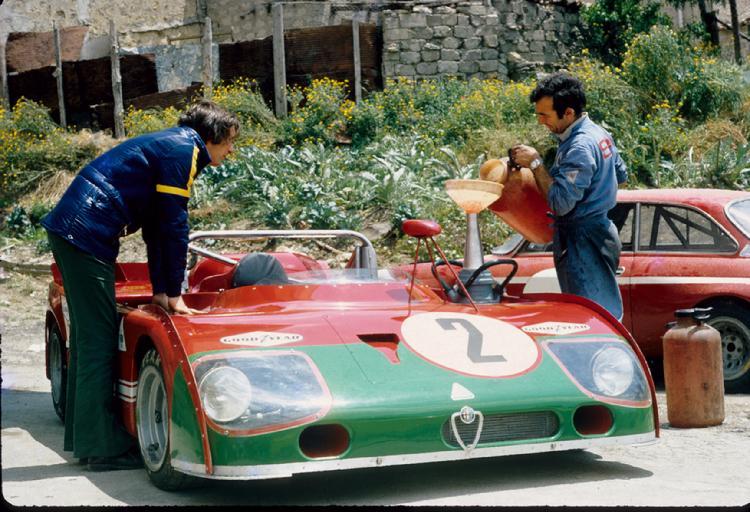
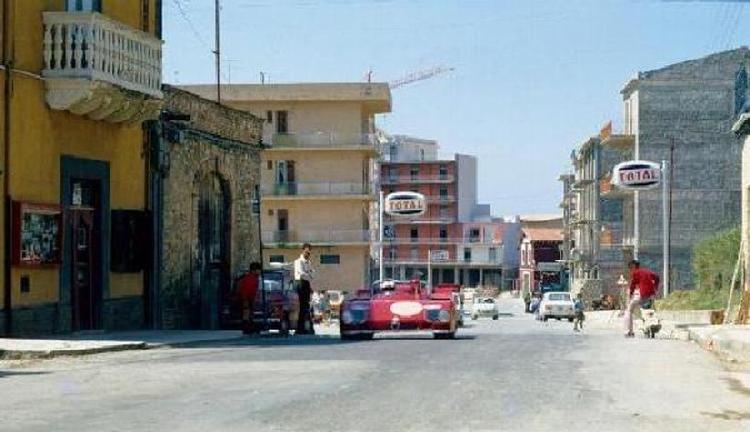
This single photograph is my overall emotional favorite among all of my experiences with Autodelta over the years...distilled down to one single iconic image at one breathtaking moment in time. 
 

This image represents the very essence of the historic Targa Florio where.... at 'full chat' ....a T-33/3 V-8 could be heard blaring in the far distant mountains long before it suddenly appeared....slicing this quiet Sicilian village of Cerda into two violently loud reverberating pieces.   
 
"And in mere seconds it is out of sight again... in an intoxicating mixture of deafening 'fighter jet' thunder, screaming tires and a blood red streak of greased lightening."


Alfa Romeo AR75080.009 

 Owned by Yves Jean-Louis Baldanza

Official Historical Transcript by Autodelta Golden Years 


                                                     by Vladimir Pajevic


Discovering the exact technical background of Alfa Romeo racing cars usually means the researcher must live within a balance of uncertainly and despair.  In this case, the car is well-known, photographically documented and declared by experts to be proven to be the car that appeared in certain venues.

The obstacle in this case involves certain expedient administrative techniques somewhat commonly used during the 1970’s.  It is a corundum facing not only today’s Alfa Romeo racing car owners of period cars but many other owners of a variety of makes.  When paperwork supplied to the official entry of a team car in a FIA event is often submitted with a common VIN for expediency…without regard to the actual VIN used in the race to be held…problems such as we observe in this case are experienced.

Autodelta was not alone in using ready-made ‘template’ documents of a car for administrative, border crossing formalities, bill of lading and for other convenience and time-saving purposes. This habit… very useful in the period, prevents or at least impedes today’s forensic researchers such as Autodelta Golden Years from tracking the exact histories of cars that are of either of present-day interest, financial investment or of historical competitive significance.

The recorded histories of Autodelta competition cars such as AR75080.009 had been notoriously sketchy and insufficiently documented in the 1970’s even before the transfer of some of the assets of the Autodelta racing division from Settimo Milanese to other individuals collectively called “Euroracing”.

These circumstances, Mr. Baldanza, apply to your car. 

Through the exploration of our highly unique database, …once the deeply hidden and closely held collection of hundreds of photographic images, prized person to person digital data exchanges and of highly privileged confidential sharing among his commercial friends and business associates...we are able to answer the questions posed to us with reasonable certainty.

This Swiss individual who was known only to those in the racing trade…knowingly and wisely… preserved this valuable information for later generations to explore and uncover history once again.

He had made appearances at nearly every Formula 1, World Championship for Makes competition and rallies and other venues for decades as a supplier’s representative to world racing teams.  

He has now deceased but gifted his Alfa Romeo treasure trove to Autodelta Golden Years.com.

Delete Building Block (and all contents)
Open Cell Alignment MenuEdit ImageDelete Image
Photographer unknown
Image Properties
 
Increase Apply
Decrease
Delete Building Block (and all contents)
Edit TextDelete Text

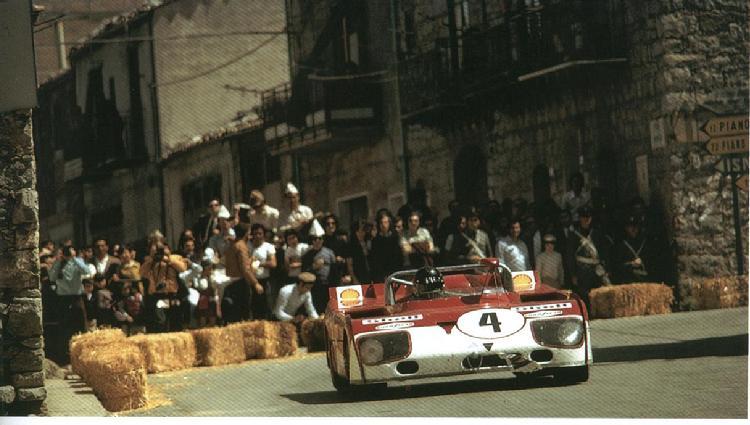
Gijs van Lennep guiding chassis AR75080.009 on the Piccolo Circuito delle Madonie, Sicily along with his teammate Andrea de Adamich during the 1971 Targa Florio.

Delete Building Block (and all contents)
Edit TextDelete Text

Owing mainly to his data treasure and our other sources, we are reasonably confident and reasonably certain that your car, AR75080.009 was and is in fact the real Autodelta AR75080.009 car. The car represents the final stage of development of the T-33/3 which was first introduced in 1969.  

The T-33/3 was Autodelta’s first monocoque racing car, based on an aluminum cell structure largely inspired by existing British designs…reinforced with titanium alloy…extremely tough and durable.

Due largely to the extremely poor and illogical assignment of a VIN, (AR11572.009) from a 12 cylinder Autodelta car of a later series, the supreme and unquestionable judgment to be applied to the accurate assignment VIN of AR75080.009 emanates ultimately from Autodelta S.p.A. and the hand of it's Directore Generale, Ing. Carlo Chiti.

Correspondence involving the hand-applied signature of Ing. Chiti supplied to Mr. Baldanza of a letter from Ing. Chiti to Pilkington dated 11.1.1974 appears from all respective angles to be authentic and the signature of Carlo Chiti appears in his usual style, size and script.

Observed physical changes made to the chassis due to its racing life experience has transformed this chassis, AR75080.009 into a modernized and updated version of a late 1970 series AR75080. -series car.   

This car was heavily damaged during the 1970 Le Mans Twenty Four Hours of Endurance event in June of 1970 and from that point the true VIN of the car was called into question, causing our team to be enlisted by the car owner Mr. Baldanza for our research expertise.   Photos from our proprietary database testify to the thorough ‘beating’ the chassis sustained at Le Mans…both to the front and to the rear of the car. 

However, the Autodelta team technicians assessed the chassis to be sufficiently intact to be successfully restored back to ready to race condition.

During the reconstruction carried out by Autodelta personnel over the summer of 1970, updated techniques planned for later versions up to the final car of the series ….AR75080.019 …such as the replacement of inner chassis structural pieces and chassis stiffeners using ‘lightening holes’ and replacement titanium panels wherever possible on the structures of the renewed version …were used through the end of the V-8 3.0-liter period…photos provided under separate cover.

Chassis dynamics of the fiberglass front and rear panels and details of that nature can be compared to the car before it was damaged.  A makeover of the entire structure was involved. 

It is reasonable to forensically deduce that the entire structure benefited from a high-level mid-season ‘restoration’ and updating.

Mr. Baldanza has offered a statement that a restorer found a fuel tank dated August 1970 which correlates logically with the Le Mans accident that had occurred two months or so before.  This is not an unusual change in fuel tanks due to the accident at Le Mans.

Again, the course of action decided by the Autodelta team in the early summer of 1970 was most assuredly planned to apply the best and latest testing research data and updates to all cars leaving the factory, including AR75080.009.

The instrumentation of the 009 was discovered to have survived the Le Mans incident unscathed.  They were original to the car’s assembly in early 1970.

Delete Building Block (and all contents)
Open Cell Alignment MenuEdit ImageDelete Image
Photographer unknown
Image Properties
 
Increase Apply
Decrease
Delete Building Block (and all contents)
Edit TextDelete Text

The 1971 Alfa Romeo T-33/3 AR75080.009 shown here at the Targa Florio driven by Andrea de Adamich.  Along with his partner Gijs van Lennep, the driving team finished second... on the 11 lap, 44.739 mile course to Nino Vacarella and Toione Hezemans... also driving an Alfa Romeo T-33/3

Delete Building Block (and all contents)
Edit TextDelete Text


Competition History


According to the data in our possession, the AR750.80.009 was produced towards the end of 1969 and tested at Balocco together with other AR750.80. sister cars from the first series.

Some statements difficult to check and confirm recall AR750.80.009 to have competed in the Sebring Twelve Hour race of March 21.1970, with the name Vega (almost all first series T33/3 had “stellar” names given by Ing. Chiti to each car) on front fenders and finished 3rd.  

The undersigned had attended to the Autodelta team at that race and made photographs of that car. Those photographs are provided under separate cover.

Later AR750.80.009 lined up for the 24 Hours of Le Mans, June 14, 1970, as a factory-sponsored car, with two Autodelta test drivers, Teodoro Zeccoli and Carlo Facetti.  

The car had the “long wheelbase” of 2320 mm as did all of the T33 / 3s of the first series.

At Le Mans, the AR750.80.009 had a serious accident near the Dunlop bridge, driven by Facetti and was withdrawn.

Towards the end of August 1970, the AR750.80.009 was redone with changes planned and incorporated for the 1971 season and featured changed aerodynamics.  

AR750.80.009, in consulting our database was not present at Targa Florio event in 1970.   

The Targa Florio was attended with a four car team of  a T-33 / 3’s of  Andrea de Adamich -  Piers Courage with AR750.80.010,  a T-33 / 3 of Toine Hezemans - Masten Gregory in AR750.80.014 and the T33 / 3 with Nanni Galli – Umberto Maglioli AR750.80.007.

The fourth car was also present in the test, probably AR75080.002 as a “T” car, tested by Masten Gregory. 

The calendar and results reported by Chiti and Autodelta in the 1971 season and presented for our consideration by Mr. Baldanza are correct and well documented.

The argument that the winning car was AR75080.005 at Brands Hatch in 1971 is incorrect.  Instead, in Ing. Chiti’s own correspondence, this AR75080.09 was the winning car piloted by Andrea de Adamich and Henri Pescarolo.

Transitions of ownership of the AR750.80.09 are probably correct as on this point we do not have certain data.

When AR750.80.009 was owned by the Red-White Museum of Peter Kaus it was declared to be  AR115.72.003, but even at the time this number was considered incorrect even by Kaus.

Later it was sold to the Louwman Museum under the wrong VIN number and when it was eventually acquired after a number of other owners prior to Mr. Baldanza’s acquisition …the number according to the documents had been amended.

The photos we have provided with this report are period correct and correspond to the VINs indicated.  For the 1971 season cars, a possible copyright conflict might arise in the distribution of one or more of the images.  We do not advise using those 1971 photographs without determining the copyright owner and seeking proper permission.


#   #   #  


The above referenced data and statements made in this report constitute the good faith effort by the Autodelta Golden Years staff and is in no way guaranteed to be factual.  No financial interest by the staff in the findings of this report shall be assumed or implied.  The staff has no financial interest in the car nor do we have any association with the present or past owners of the car.   Our reports are constructed on an arms-length data gathering basis.    No liability will be accepted by Autodelta Golden Years or its staff regarding any contents of the report and no legal liability or financial interest shall be construed or implied by its findings.   

Copyright 2022

First date of publication:  February 14, 2022

All Rights Reserved

Robert B. Little

Team Manager

AutodeltaGoldenYears.com

Delete Building Block (and all contents)
Open Cell Alignment MenuEdit ImageDelete Image

Discovering the exact technical background of Alfa Romeo racing cars usually means the researcher must live within a balance of uncertainly and despair.  In this case, the car is well-known, photographically documented and declared by experts to be proven to be the car that appeared in certain venues.

The obstacle in this case involves certain expedient administrative techniques somewhat commonly used during the 1970’s.  It is a corundum facing not only today’s Alfa Romeo racing car owners of period cars but many other owners of a variety of makes.  When paperwork supplied to the official entry of a team car in a FIA event is often submitted with a common VIN for expediency…without regard to the actual VIN used in the race to be held…problems such as we observe in this case are experienced.

Autodelta was not alone in using ready-made ‘template’ documents of a car for administrative, border crossing formalities, bill of lading and for other convenience and time-saving purposes. This habit… very useful in the period, prevents or at least impedes today’s forensic researchers such as Autodelta Golden Years from tracking the exact histories of cars that are of either of present-day interest, financial investment or of historical competitive significance.

The recorded histories of Autodelta competition cars such as AR75080.009 had been notoriously sketchy and insufficiently documented in the 1970’s even before the transfer of some of the assets of the Autodelta racing division from Settimo Milanese to other individuals collectively called “Euroracing”.

These circumstances, Mr. Baldanza, apply to your car. 

Through the exploration of our highly unique database, …once the deeply hidden and closely held collection of hundreds of photographic images, prized person to person digital data exchanges and of highly privileged confidential sharing among his commercial friends and business associates...we are able to answer the questions posed to us with reasonable certainty.

This Swiss individual who was known only to those in the racing trade…knowingly and wisely… preserved this valuable information for later generations to explore and uncover history once again.

He had made appearances at nearly every Formula 1, World Championship for Makes competition and rallies and other venues for decades as a supplier’s representative to world racing teams.  

He has now deceased but gifted his Alfa Romeo treasure trove to Autodelta Golden Years.com.

Delete Building Block (and all contents)
Open Cell Alignment MenuEdit ImageDelete Image
Photographer unknown
Image Properties
 
Increase Apply
Decrease
Delete Building Block (and all contents)
Edit TextDelete Text

Gijs van Lennep guiding chassis AR75080.009 on the Piccolo Circuito delle Madonie, Sicily along with his teammate Andrea de Adamich during the 1971 Targa Florio.

Delete Building Block (and all contents)
Edit TextDelete Text

Owing mainly to his data treasure and our other sources, we are reasonably confident and reasonably certain that your car, AR75080.009 was and is in fact the real Autodelta AR75080.009 car. The car represents the final stage of development of the T-33/3 which was first introduced in 1969.  

The T-33/3 was Autodelta’s first monocoque racing car, based on an aluminum cell structure largely inspired by existing British designs…reinforced with titanium alloy…extremely tough and durable.

Due largely to the extremely poor and illogical assignment of a VIN, (AR11572.009) from a 12 cylinder Autodelta car of a later series, the supreme and unquestionable judgment to be applied to the accurate assignment VIN of AR75080.009 emanates ultimately from Autodelta S.p.A. and the hand of it's Directore Generale, Ing. Carlo Chiti.

Correspondence involving the hand-applied signature of Ing. Chiti supplied to Mr. Baldanza of a letter from Ing. Chiti to Pilkington dated 11.1.1974 appears from all respective angles to be authentic and the signature of Carlo Chiti appears in his usual style, size and script.

Observed physical changes made to the chassis due to its racing life experience has transformed this chassis, AR75080.009 into a modernized and updated version of a late 1970 series AR75080. -series car.   

This car was heavily damaged during the 1970 Le Mans Twenty Four Hours of Endurance event in June of 1970 and from that point the true VIN of the car was called into question, causing our team to be enlisted by the car owner Mr. Baldanza for our research expertise.   Photos from our proprietary database testify to the thorough ‘beating’ the chassis sustained at Le Mans…both to the front and to the rear of the car. 

However, the Autodelta team technicians assessed the chassis to be sufficiently intact to be successfully restored back to ready to race condition.

During the reconstruction carried out by Autodelta personnel over the summer of 1970, updated techniques planned for later versions up to the final car of the series ….AR75080.019 …such as the replacement of inner chassis structural pieces and chassis stiffeners using ‘lightening holes’ and replacement titanium panels wherever possible on the structures of the renewed version …were used through the end of the V-8 3.0-liter period…photos provided under separate cover.

Chassis dynamics of the fiberglass front and rear panels and details of that nature can be compared to the car before it was damaged.  A makeover of the entire structure was involved. 

It is reasonable to forensically deduce that the entire structure benefited from a high-level mid-season ‘restoration’ and updating.

Mr. Baldanza has offered a statement that a restorer found a fuel tank dated August 1970 which correlates logically with the Le Mans accident that had occurred two months or so before.  This is not an unusual change in fuel tanks due to the accident at Le Mans.

Again, the course of action decided by the Autodelta team in the early summer of 1970 was most assuredly planned to apply the best and latest testing research data and updates to all cars leaving the factory, including AR75080.009.

The instrumentation of the 009 was discovered to have survived the Le Mans incident unscathed.  They were original to the car’s assembly in early 1970.

Delete Building Block (and all contents)
Open Cell Alignment MenuEdit ImageDelete Image
Photographer unknown
Image Properties
 
Increase Apply
Decrease
Delete Building Block (and all contents)
Edit TextDelete Text

The 1971 Alfa Romeo T-33/3 AR75080.009 shown here at the Targa Florio driven by Andrea de Adamich.  Along with his partner Gijs van Lennep, the driving team finished second... on the 11 lap, 44.739 mile course to Nino Vacarella and Toione Hezemans... also driving an Alfa Romeo T-33/3

Delete Building Block (and all contents)
Edit TextDelete Text


Competition History


According to the data in our possession, the AR750.80.009 was produced towards the end of 1969 and tested at Balocco together with other AR750.80. sister cars from the first series.

Some statements difficult to check and confirm recall AR750.80.009 to have competed in the Sebring Twelve Hour race of March 21.1970, with the name Vega (almost all first series T33/3 had “stellar” names given by Ing. Chiti to each car) on front fenders and finished 3rd.  

The undersigned had attended to the Autodelta team at that race and made photographs of that car. Those photographs are provided under separate cover.

Later AR750.80.009 lined up for the 24 Hours of Le Mans, June 14, 1970, as a factory-sponsored car, with two Autodelta test drivers, Teodoro Zeccoli and Carlo Facetti.  

The car had the “long wheelbase” of 2320 mm as did all of the T33 / 3s of the first series.

At Le Mans, the AR750.80.009 had a serious accident near the Dunlop bridge, driven by Facetti and was withdrawn.

Towards the end of August 1970, the AR750.80.009 was redone with changes planned and incorporated for the 1971 season and featured changed aerodynamics.  

AR750.80.009, in consulting our database was not present at Targa Florio event in 1970.   

The Targa Florio was attended with a four car team of  a T-33 / 3’s of  Andrea de Adamich -  Piers Courage with AR750.80.010,  a T-33 / 3 of Toine Hezemans - Masten Gregory in AR750.80.014 and the T33 / 3 with Nanni Galli – Umberto Maglioli AR750.80.007.

The fourth car was also present in the test, probably AR75080.002 as a “T” car, tested by Masten Gregory. 

The calendar and results reported by Chiti and Autodelta in the 1971 season and presented for our consideration by Mr. Baldanza are correct and well documented.

The argument that the winning car was AR75080.005 at Brands Hatch in 1971 is incorrect.  Instead, in Ing. Chiti’s own correspondence, this AR75080.09 was the winning car piloted by Andrea de Adamich and Henri Pescarolo.

Transitions of ownership of the AR750.80.09 are probably correct as on this point we do not have certain data.

When AR750.80.009 was owned by the Red-White Museum of Peter Kaus it was declared to be  AR115.72.003, but even at the time this number was considered incorrect even by Kaus.

Later it was sold to the Louwman Museum under the wrong VIN number and when it was eventually acquired after a number of other owners prior to Mr. Baldanza’s acquisition …the number according to the documents had been amended.

The photos we have provided with this report are period correct and correspond to the VINs indicated.  For the 1971 season cars, a possible copyright conflict might arise in the distribution of one or more of the images.  We do not advise using those 1971 photographs without determining the copyright owner and seeking proper permission.


#   #   #  


The above referenced data and statements made in this report constitute the good faith effort by the Autodelta Golden Years staff and is in no way guaranteed to be factual.  No financial interest by the staff in the findings of this report shall be assumed or implied.  The staff has no financial interest in the car nor do we have any association with the present or past owners of the car.   Our reports are constructed on an arms-length data gathering basis.    No liability will be accepted by Autodelta Golden Years or its staff regarding any contents of the report and no legal liability or financial interest shall be construed or implied by its findings.   

Copyright 2022

First date of publication:  February 14, 2022

All Rights Reserved

Robert B. Little

Team Manager

AutodeltaGoldenYears.com

Delete Building Block (and all contents)
Open Cell Alignment MenuEdit ImageDelete Image

Discovering the exact technical background of Alfa Romeo racing cars usually means the researcher must live within a balance of uncertainly and despair.  In this case, the car is well-known, photographically documented and declared by experts to be proven to be the car that appeared in certain venues.

The obstacle in this case involves certain expedient administrative techniques somewhat commonly used during the 1970’s.  It is a corundum facing not only today’s Alfa Romeo racing car owners of period cars but many other owners of a variety of makes.  When paperwork supplied to the official entry of a team car in a FIA event is often submitted with a common VIN for expediency…without regard to the actual VIN used in the race to be held…problems such as we observe in this case are experienced.

Autodelta was not alone in using ready-made ‘template’ documents of a car for administrative, border crossing formalities, bill of lading and for other convenience and time-saving purposes. This habit… very useful in the period, prevents or at least impedes today’s forensic researchers such as Autodelta Golden Years from tracking the exact histories of cars that are of either of present-day interest, financial investment or of historical competitive significance.

The recorded histories of Autodelta competition cars such as AR75080.009 had been notoriously sketchy and insufficiently documented in the 1970’s even before the transfer of some of the assets of the Autodelta racing division from Settimo Milanese to other individuals collectively called “Euroracing”.

These circumstances, Mr. Baldanza, apply to your car. 

Through the exploration of our highly unique database, …once the deeply hidden and closely held collection of hundreds of photographic images, prized person to person digital data exchanges and of highly privileged confidential sharing among his commercial friends and business associates...we are able to answer the questions posed to us with reasonable certainty.

This Swiss individual who was known only to those in the racing trade…knowingly and wisely… preserved this valuable information for later generations to explore and uncover history once again.

He had made appearances at nearly every Formula 1, World Championship for Makes competition and rallies and other venues for decades as a supplier’s representative to world racing teams.  

He has now deceased but gifted his Alfa Romeo treasure trove to Autodelta Golden Years.com.

Delete Building Block (and all contents)
Open Cell Alignment MenuEdit ImageDelete Image
Photographer unknown
Image Properties
 
Increase Apply
Decrease
Delete Building Block (and all contents)
Edit TextDelete Text

Gijs van Lennep guiding chassis AR75080.009 on the Piccolo Circuito delle Madonie, Sicily along with his teammate Andrea de Adamich during the 1971 Targa Florio.

Delete Building Block (and all contents)
Edit TextDelete Text

Owing mainly to his data treasure and our other sources, we are reasonably confident and reasonably certain that your car, AR75080.009 was and is in fact the real Autodelta AR75080.009 car. The car represents the final stage of development of the T-33/3 which was first introduced in 1969.  

The T-33/3 was Autodelta’s first monocoque racing car, based on an aluminum cell structure largely inspired by existing British designs…reinforced with titanium alloy…extremely tough and durable.

Due largely to the extremely poor and illogical assignment of a VIN, (AR11572.009) from a 12 cylinder Autodelta car of a later series, the supreme and unquestionable judgment to be applied to the accurate assignment VIN of AR75080.009 emanates ultimately from Autodelta S.p.A. and the hand of it's Directore Generale, Ing. Carlo Chiti.

Correspondence involving the hand-applied signature of Ing. Chiti supplied to Mr. Baldanza of a letter from Ing. Chiti to Pilkington dated 11.1.1974 appears from all respective angles to be authentic and the signature of Carlo Chiti appears in his usual style, size and script.

Observed physical changes made to the chassis due to its racing life experience has transformed this chassis, AR75080.009 into a modernized and updated version of a late 1970 series AR75080. -series car.   

This car was heavily damaged during the 1970 Le Mans Twenty Four Hours of Endurance event in June of 1970 and from that point the true VIN of the car was called into question, causing our team to be enlisted by the car owner Mr. Baldanza for our research expertise.   Photos from our proprietary database testify to the thorough ‘beating’ the chassis sustained at Le Mans…both to the front and to the rear of the car. 

However, the Autodelta team technicians assessed the chassis to be sufficiently intact to be successfully restored back to ready to race condition.

During the reconstruction carried out by Autodelta personnel over the summer of 1970, updated techniques planned for later versions up to the final car of the series ….AR75080.019 …such as the replacement of inner chassis structural pieces and chassis stiffeners using ‘lightening holes’ and replacement titanium panels wherever possible on the structures of the renewed version …were used through the end of the V-8 3.0-liter period…photos provided under separate cover.

Chassis dynamics of the fiberglass front and rear panels and details of that nature can be compared to the car before it was damaged.  A makeover of the entire structure was involved. 

It is reasonable to forensically deduce that the entire structure benefited from a high-level mid-season ‘restoration’ and updating.

Mr. Baldanza has offered a statement that a restorer found a fuel tank dated August 1970 which correlates logically with the Le Mans accident that had occurred two months or so before.  This is not an unusual change in fuel tanks due to the accident at Le Mans.

Again, the course of action decided by the Autodelta team in the early summer of 1970 was most assuredly planned to apply the best and latest testing research data and updates to all cars leaving the factory, including AR75080.009.

The instrumentation of the 009 was discovered to have survived the Le Mans incident unscathed.  They were original to the car’s assembly in early 1970.

Delete Building Block (and all contents)
Open Cell Alignment MenuEdit ImageDelete Image
Photographer unknown
Image Properties
 
Increase Apply
Decrease
Delete Building Block (and all contents)
Edit TextDelete Text

The 1971 Alfa Romeo T-33/3 AR75080.009 shown here at the Targa Florio driven by Andrea de Adamich.  Along with his partner Gijs van Lennep, the driving team finished second... on the 11 lap, 44.739 mile course to Nino Vacarella and Toione Hezemans... also driving an Alfa Romeo T-33/3

Delete Building Block (and all contents)
Edit TextDelete Text


Competition History


According to the data in our possession, the AR750.80.009 was produced towards the end of 1969 and tested at Balocco together with other AR750.80. sister cars from the first series.

Some statements difficult to check and confirm recall AR750.80.009 to have competed in the Sebring Twelve Hour race of March 21.1970, with the name Vega (almost all first series T33/3 had “stellar” names given by Ing. Chiti to each car) on front fenders and finished 3rd.  

The undersigned had attended to the Autodelta team at that race and made photographs of that car. Those photographs are provided under separate cover.

Later AR750.80.009 lined up for the 24 Hours of Le Mans, June 14, 1970, as a factory-sponsored car, with two Autodelta test drivers, Teodoro Zeccoli and Carlo Facetti.  

The car had the “long wheelbase” of 2320 mm as did all of the T33 / 3s of the first series.

At Le Mans, the AR750.80.009 had a serious accident near the Dunlop bridge, driven by Facetti and was withdrawn.

Towards the end of August 1970, the AR750.80.009 was redone with changes planned and incorporated for the 1971 season and featured changed aerodynamics.  

AR750.80.009, in consulting our database was not present at Targa Florio event in 1970.   

The Targa Florio was attended with a four car team of  a T-33 / 3’s of  Andrea de Adamich -  Piers Courage with AR750.80.010,  a T-33 / 3 of Toine Hezemans - Masten Gregory in AR750.80.014 and the T33 / 3 with Nanni Galli – Umberto Maglioli AR750.80.007.

The fourth car was also present in the test, probably AR75080.002 as a “T” car, tested by Masten Gregory. 

The calendar and results reported by Chiti and Autodelta in the 1971 season and presented for our consideration by Mr. Baldanza are correct and well documented.

The argument that the winning car was AR75080.005 at Brands Hatch in 1971 is incorrect.  Instead, in Ing. Chiti’s own correspondence, this AR75080.09 was the winning car piloted by Andrea de Adamich and Henri Pescarolo.

Transitions of ownership of the AR750.80.09 are probably correct as on this point we do not have certain data.

When AR750.80.009 was owned by the Red-White Museum of Peter Kaus it was declared to be  AR115.72.003, but even at the time this number was considered incorrect even by Kaus.

Later it was sold to the Louwman Museum under the wrong VIN number and when it was eventually acquired after a number of other owners prior to Mr. Baldanza’s acquisition …the number according to the documents had been amended.

The photos we have provided with this report are period correct and correspond to the VINs indicated.  For the 1971 season cars, a possible copyright conflict might arise in the distribution of one or more of the images.  We do not advise using those 1971 photographs without determining the copyright owner and seeking proper permission.


#   #   #  


The above referenced data and statements made in this report constitute the good faith effort by the Autodelta Golden Years staff and is in no way guaranteed to be factual.  No financial interest by the staff in the findings of this report shall be assumed or implied.  The staff has no financial interest in the car nor do we have any association with the present or past owners of the car.   Our reports are constructed on an arms-length data gathering basis.    No liability will be accepted by Autodelta Golden Years or its staff regarding any contents of the report and no legal liability or financial interest shall be construed or implied by its findings.   

Copyright 2022

First date of publication:  February 14, 2022

All Rights Reserved

Robert B. Little

Team Manager

AutodeltaGoldenYears.com

Delete Building Block (and all contents)
Open Cell Alignment MenuEdit ImageDelete Image


Policy of this Website in Regard to the Use of Images Whose Ownership is Not Known or is Otherwise Unidentifiable.

AutodeltaGoldenYears.com. and RobertLittle.US contributes collection images where the Website Content is described as having “no known copyright restriction.” The phrase “no known copyright restriction” means that AutodeltaGoldenYears.com and RobertLittle.US has determined, to the best of its ability based on available information and belief, that the Website Content is unlikely to be protected by copyright interests and, in all likelihood, is in the public domain.

However, copyright is often difficult to determine with certainty, so the phrase is intended to say that AutodeltaGoldenYears.com and RobertLittle.US is unaware of any copyright restriction, but such restrictions may still exist.

In addition, even if the Website Content is unrestricted from a copyright standpoint, there may be other considerations that would limit your use, such as “Right of Privacy” or “Right of Publicity” of the individuals featured in the images, or other contractual restrictions.

For these reasons, AutodeltaGoldenYears.com and RobertLittle.US makes its content available for personal and non-commercial educational uses consistent with the principles of “fair use”.

If you decide to use the Website Content for commercial or other purposes without undertaking to clear all rights, you will be responsible if someone else owns the rights and the owner objects to your use.

Of course, the use of images identified as being the copyright property of the named individuals or groups identified on each page or attached to each image… is prohibited and is subject to the penalty of law as provided by the United States Copyright law and The Bern Convention among other relevant laws and protections.

Richtlinie dieser Website in Bezug auf die Verwendung von Bildern, deren Rechteinhaber nicht bekannt oder anderweitig nicht identifizierbar ist:

AutodeltaGoldenYears.com. und RobertLittle.US stellen Abbildungen, insbesondere Fotos, zur Verfügung, die als "keine bekannte Copyright-Beschränkung" bezeichnet werden. Die Formulierung "keine bekannte Copyright-Beschränkung" bedeutet, dass AutodeltaGoldenYears.com und RobertLittle.US. nach bestem Wissen und Gewissen festgestellt haben, dass die Abbildungen/Fotos wahrscheinlich nicht urheberrechtlich geschützt sind und sich aller Wahrscheinlichkeit nach in der Public Domain befinden.

Allerdings ist es oft schwierig, das Urheberrecht mit Sicherheit zu bestimmen, so dass der Satz besagt, dass AutodeltaGoldenYears.com und RobertLittle.US keine Kenntnis von urheberrechtlichen Beschränkungen haben, aber solche Beschränkungen dennoch bestehen können.

Darüber hinaus kann es, selbst wenn der Inhalt der Website aus urheberrechtlicher Sicht uneingeschränkt ist, andere Erwägungen geben, die Ihre Nutzung einschränken können, wie z.B. das "Recht auf Privatsphäre" oder das "Recht auf Öffentlichkeit" der auf den Bildern abgebildeten Personen oder andere vertragliche Einschränkungen.

Aus diesen Gründen stellt AutodeltaGoldenYears.com und RobertLittle.US seine Inhalte für persönliche und nicht-kommerzielle Bildungszwecke in Übereinstimmung mit den Grundsätzen des "fair use" zur Verfügung.

Wenn Sie sich entscheiden, den Inhalt der Website für kommerzielle oder andere Zwecke zu nutzen, ohne sich zu verpflichten, alle Rechte zu klären, sind Sie dafür verantwortlich, wenn jemand anderes die Rechte besitzt und der Eigentümer Ihrer Nutzung widerspricht.

Natürlich ist die Verwendung von Bildern, die als urheberrechtliches Eigentum der auf jeder Seite genannten Einzelpersonen oder Gruppen gekennzeichnet sind oder die jedem Bild beigefügt sind, verboten und wird entsprechend dem Urheberrechtsgesetz der USA und der Berner Konvention neben anderen relevanten Gesetzen und Schutzmaßnahmen geahndet.

Politica di questo sito web riguardo l'uso di immagini la cui proprietà non è nota o è altrimenti non identificabile.

AutodeltaGoldenYears.com e RobertLittle.US forniscono immagini, in particolare fotografie, alle quali si fa riferimento come non aventi "nessuna restrizione di copyright nota". La definizione "nessuna restrizione di copyright nota" sta ad indicare che AutodeltaGoldenYears.com e RobertLittle.US hanno determinato, al meglio delle proprie capacità e sulla base delle informazioni e conoscenze disponibili, che è implausibile che le immagini siano protette da copyright, e che pertanto con ogni probabilità sono di dominio pubblico.

Tuttavia il copyright è spesso difficile da determinare con certezza, per cui con tale definizione si intende dire piuttosto che AutodeltaGoldenYears.com e RobertLittle.US non sono a conoscenza di alcuna restrizione sul copyright, sebbene tali restrizioni possano comunque esistere.

Inoltre, anche nei casi in cui il contenuto del sito web sia privo di limitazioni dal punto di vista del copyright, ciò non esclude che possano esserci altre considerazioni che ne limitino l'utilizzo, come il diritto alla privacy o il diritto all’immagine delle persone presenti nelle fotografie, o restrizioni di tipo contrattuale.

Per questi motivi, AutodeltaGoldenYears.com e RobertLittle.US rendono i propri contenuti disponibili per usi educativi personali e non commerciali, in conformità ai principi del "fair use".

Qualora decidessi di usare il contenuto del sito web per scopi commerciali o di altro tipo senza la previa acquisizione di tutti i diritti, sarai responsabile se qualcun altro detiene tali diritti e si oppone al tuo utilizzo.

Naturalmente, l'uso di immagini contrassegnate come protette da copyright di cui sono titolari individui o gruppi identificati in ciascuna pagina o allegati a ciascuna immagine, è proibito ed è soggetto alle sanzioni previste dalla legge sul copyright degli Stati Uniti e dalla Convenzione di Berna, oltre che dalle altre leggi e protezioni pertinenti.